AI tools for agencies come in various forms – from pure AI chats to AI platforms for teams to project software with AI features.
But the real lever isn't the individual tool – it's the AI rollout across the entire agency: AI that runs on your projects, clients and time.
We'll show you 8 tools, including their target audience and features – and where awork comes in. 💜
What are AI tools for agencies?
[.b-important-block]AI tools for agencies are software solutions that use artificial intelligence to support creative and operational work – from copywriting to research to project management. For agencies, they're no longer a "nice-to-have": the question is no longer whether AI is used, but how it's embedded in the value chain.[.b-important-block]
[$tag]💡 Good to know[$tag]
Adoption is already here. According to the Agency Happiness Report 2026 (500 agency employees surveyed), 98% use AI in their work, and a good half of them use it daily – only 2% never do. AI has long since arrived in the day-to-day agency routine.
But the catch lies elsewhere. In the same report, only 16% consider their agency fully AI-ready. In other words: almost everyone works with AI, but hardly anyone feels that the structures and processes behind it are truly in place.
And that's exactly the point. The real building site isn't the next tool, but the organisation behind it: how is AI embedded along the value chain, shared across the team and cleanly managed?
Because those who use AI to clear the time-wasters out of the working day gain room for what clients really pay for – ideas, strategy, craft. No single tool closes that gap – only a well-thought-out AI rollout for the whole agency.
What matters most in AI tools for agencies?
[.toc-name]What matters most in AI tools[.toc-name]
A good AI tool for the agency doesn't just bring a strong language model. It knows your agency context, can be shared across the team, keeps client data cleanly separated and makes usage transparent.
A chatbot that writes copy from prompts is quickly found. The criteria that really count in agency operations are more demanding. Keep these six points in mind as you work through the tools:
- Structure & context as the foundation.
Does the AI automatically run on the right agency context – projects, clients, tasks – or does everyone have to supply it afresh with every prompt? Only shared context produces consistent results instead of ten individual versions.
- Agency-specific agents out of the box.
Are there ready-made agents for typical agency cases – such as a briefing check, brand safety, or a persona agent – or does everything have to be built from scratch on a generic basis?
- Team-wide sharing.
Can agents and skills be shared right where everyone already works – including for the non-techy colleagues? Or does each person build their own AI systems?
- LLM independence & GDPR.
Are you tied to a single provider, or can you use the best model for the job? And does everything run in a GDPR-compliant way, as client projects demand?
- Clear permissions management.
Does client data stay within its respective project scope, so nothing leaks out? And, internally too, not everyone has access to everything.
- Trackable AI usage.
Can AI costs be broken down per project and client, and passed on?
8 AI tools for agencies at a glance
[.toc-name]8 AI tools at a glance[.toc-name]
AI tools come in various forms – from pure AI chats to AI platforms for teams to project software with AI features. Each form solves part of the puzzle. awork delivers the AI rollout for the whole agency.
1. awork – the AI tool your whole agency runs on
Target audience: Agencies that plan as a team, work in client projects and bill time
Features: AI chat, team-wide shared agents & skills, project management, capacity planning, time tracking & billability, awork Docs for context and knowledge management
awork is the project management tool for agencies, and it already brings your projects, plans, teams, time and clients together in one place. That's exactly where the AI comes in properly: it runs directly on these structures, with real agency knowledge, for the whole team rather than just for individual users.
[.b-button-primary]Request a demo[.b-button-primary]
2. ChatGPT
Target audience: individual creatives, strategists, researchers
Features: copywriting, ideation, summarising, analysis
ChatGPT is the quickest way to bring AI into your daily work, and it's often helpful for the individual task. It's especially strong for individual creatives and strategists who want to work quickly on ideas and copy.
What ChatGPT doesn't know is your clients, the briefings and the specific projects.
3. Claude Cowork
Target audience: creatives and strategists focused on research and concept work
Features: strong reasoning, long contexts, analysis of longer documents
Claude Cowork shines at demanding reasoning and long contexts – great for research and concepts. Claude plays to its strengths when you're working with AI on longer documents and complex analyses. Like other AI chats, Claude runs alongside your project work.
4. Gemini
Target audience: teams working closely within the Google ecosystem
Features: AI in Docs, Sheets, Gmail; research and copywriting within Workspace
Gemini is deeply integrated into Google Workspace and handy if your agency already runs on it. Gemini knows your Docs and emails – but not your utilisation, time budgets and client projects.
5. Langdock
Target audience: teams that want to give all employees secure AI access
Features: model-independent AI chat, custom assistants, prompt library, EU hosting, governance
Langdock is a strong, secure and model-independent AI platform with EU hosting – the big step up from individual AI subscriptions. It's a good fit if you want to give all employees secure, GDPR-compliant AI access across the board. Projects, clients, utilisation and time you'll need to rebuild yourself for your agency.
6. Asana
Target audience: teams in any industry managing goals and projects across departments
Features: task and project management, automations, AI Studio & AI Teammates
Asana is a comprehensive platform with a clear strength in goal and portfolio management (Goals, OKRs) across many departments, and a good choice for organisations orchestrating goals and portfolios across teams. The AI workflows take over routine work, but they aren't tailored to agency cases.
7. ClickUp
Target audience: teams that want a highly flexible all-in-one tool
Features: task management, 15+ views, dashboards, ClickUp Brain
ClickUp is maximally configurable and, as an all-in-one, covers a great deal; ClickUp Brain searches the workspace and automates via prompt. ClickUp is worth it if you want one tool for everything and are willing to invest in the custom setup – the agency logic you'll need to integrate yourself.
8. monday.com
Target audience: teams looking for a flexible "Work OS" for many workflows
Features: visual boards, strong automations, monday AI
monday is a highly flexible "Work OS" with a very visual board UX and automations for cross-departmental workflows. EU hosting is only included in the Enterprise plan. Agency-specific budget and profitability logic isn't built in.
[.no-toc]AI tools for agencies compared[.no-toc]
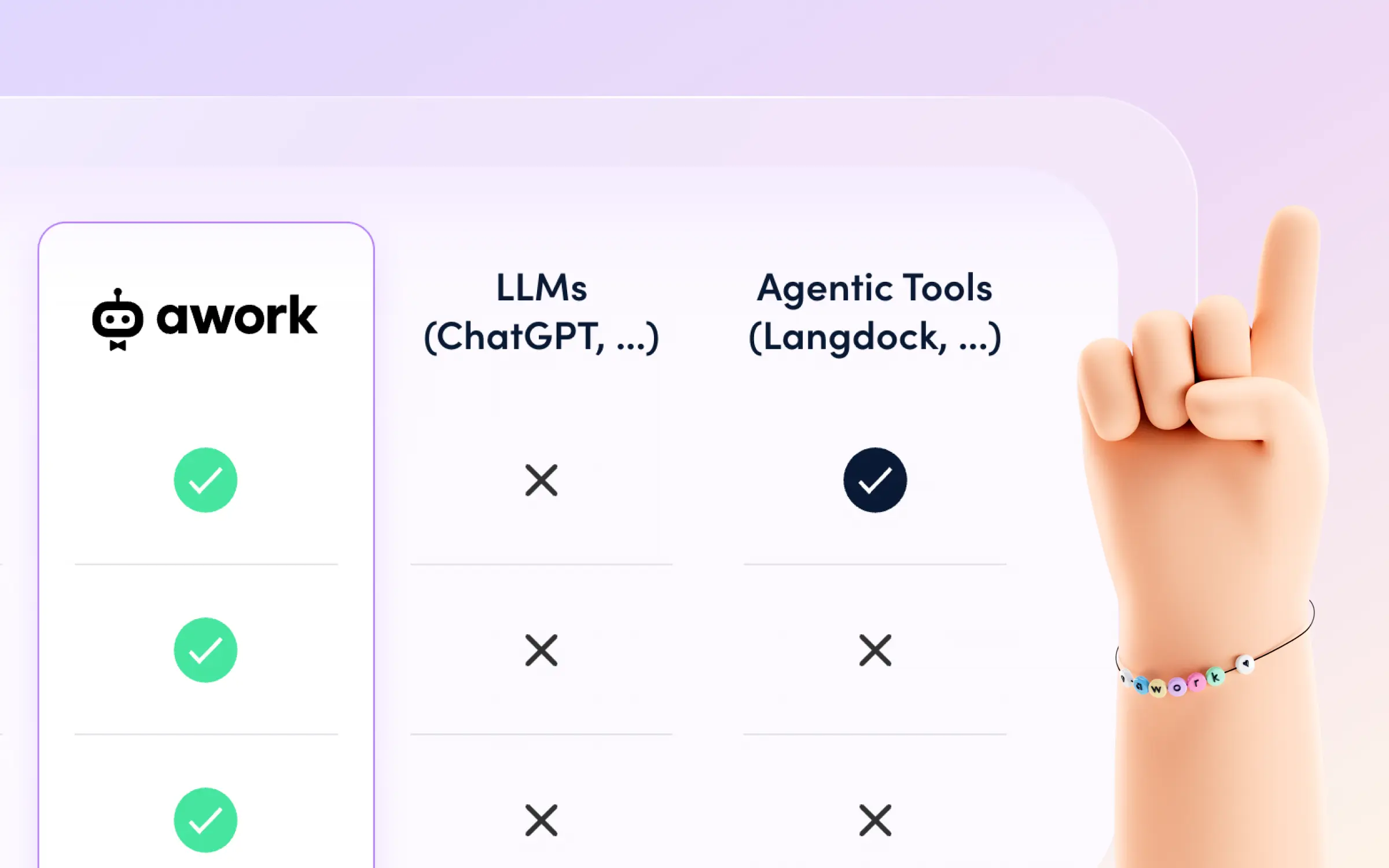
Pure AI chats are flexible, but without shared context. AI platforms are secure, but not agency-specific. Project software organises tasks, but doesn't map agency logic natively. awork combines both – AI on a native agency structure.
The pattern is clear: each tool group covers a small piece. The pure AI chats bring the model, but no shared context. Langdock brings security and model freedom, but no agency structure. Asana, ClickUp and monday organise tasks, but leave the agency logic to you. awork is the only tool that carries all the way through – because the AI runs directly on the agency structure.
[.b-button-primary]Request a demo[.b-button-primary]
A single AI tool or AI for the whole agency operations?
[.toc-name]AI for the agency operations[.toc-name]
An AI rollout for agencies means: AI doesn't run as an island solution for individual people, but across the entire agency structure – projects, clients, utilisation, time – as a shared tool for the whole team.
This is where the real difference lies.
An AI chat, an AI platform and an AI feature within the project tool are each useful in their own right. But when they stand side by side, unconnected, they slow agencies down: through fragmented usage, where everyone runs their own tool on their own initiative – with different context, inconsistent results and unclear costs.
The reframe that helps: the question isn't "Which AI tool do we choose?" but "What does our AI run on?".
Because AI is only as good as its context. When plans, projects, teams and time all sit in one place, the AI automatically works with real agency knowledge – instead of starting from scratch with every prompt.
That's why the whole team should work on one basis:
- Consistent results instead of ten individual context versions
- No knowledge silo: shared agents and skills that everyone uses
- Clear permissions: client data stays within its project scope
- Transparent costs: AI usage traceable per project and client
- The agency improves as a whole – not just individual power users
Conclusion: Which tools awork replaces
Rather than passing judgement on "the best tool", it's worth looking at the stack.
awork bundles what agencies otherwise spread across four or more separate tools:
- Project management – Asana, monday & Co. → team and project management, built in from the start
- Time tracking & billability – Toggl, Harvest & Co. → natively integrated, no separate tool
- AI tools – Claude, Langdock & Co. → team-wide shared agents, skills and AI features right inside your projects
- Documentation – Notion, Confluence & Co. → awork Docs plus AI context in one place
Fewer subscriptions. Everything in one place. And which tool when? For quick individual tasks, a pure AI chat is enough. If you want to give all employees secure, industry-neutral AI access, an AI platform makes sense.
But as soon as you're planning client projects, billing time and want to roll out AI usage across the whole agency team, awork is the right choice.
At a glance:
- ✅ AI is standard in the day-to-day agency routine (98% usage) – the organisation behind it is the real building site
- ✅ Individual tools solve tasks; a shared basis solves the silo problem
- ✅ awork combines project management, time tracking and AI – model-independent and GDPR-compliant
👉 Next step: Take a look at the agents your agency can roll out in awork today – from the briefing checker to the brand safety agent.
[.no-toc]FAQ[.no-toc]
Does awork replace ChatGPT or Claude?
awork brings AI chat directly into your projects – based on your agency context and model-independent, so every request runs on the LLM that delivers the best result. For many everyday questions, this replaces the separate AI chat. The difference: in awork, the AI knows the client, briefing and planning, instead of starting from scratch every time.
Are AI tools for agencies GDPR-compliant?
That depends heavily on the tool. Pure US AI chats often process data outside the EU, and full data residency is frequently only available on the Enterprise plan with generic project tools. awork is ISO 27001-certified, GDPR-compliant, and your data stays in the EU – on every plan. Your data is never used to train models.
Can we migrate existing AI agents and projects?
Yes. Via the MCP connector, existing agents can even be rebuilt in awork by the AI itself – so you don't start from scratch, but carry on from where you already are.
Which agencies is awork suited to?
awork is built for creative agencies – marketing, digital, communications, brand. If you work in client projects, plan as a team and bill time, awork fits into your processes.
[.b-button-primary]Request a demo[.b-button-primary]


.webp)