An overview of the 6 phases of the AI roll-out
- Generic AI use: Individuals improve their skills.
- Verbal best practices: Experiences are shared informally (this is where most agencies are at).
- Agency knowledge: AI operates within a centralised context.
- Agency tools: AI acts within your systems.
- Specialised agents: dedicated, shared agents.
- Agent-driven agency: People orchestrate, agents deliver.
You often read that “AI will completely transform the labour market”. That isn’t quite right. Why?
AI has already completely transformed the labour market.
Some sectors may still be able to sit back a little and take a leisurely approach to the AI rollout. Other industries, particularly agencies, must roll out AI sensibly now (!) in order to remain relevant in the long term.
To ensure this succeeds, in this article we’ll be addressing the following questions:
- What exactly is an AI rollout?
- What is the goal?
- How do I go about it?
What is an “AI rollout”?
If the term ‘rollout’ means absolutely nothing to you, here’s a brief explanation: the term ‘rollout’ is used primarily in the software sector, for example, when a new feature is made available across the board for the entire product.
To use a metaphor: your favourite football club’s stadium is getting a new pitch laid. The turf is rolled out strip by strip across the entire surface and laid end-to-end without any gaps. The better the turf is laid, the better everyone can play on it together.
So what does this mean for your agency and the AI rollout?
AI isn’t simply a feature that can be rolled out quickly and easily. An AI rollout is complex and involves various phases.
We have been working on these phases over the past few months through client interviews, workshops and our own data collection involving hundreds of agencies. The result is a six-phase model that can be used to map out the AI roll-out.
Many agencies find themselves in the second phase:
They are already working with AI tools such as ChatGPT, Gemini or Claude, and individual agency use cases are already being presented. The motto is, in a way: every man for himself, doing the best he can. The next step – in this case, Phase 3 – is usually unclear or not immediately apparent.
To understand what the next step might be, regardless of which phase you’re in, you should ask yourself: What are the obstacles? What is holding our agency back?
Challenging AI rollout: These are the obstacles
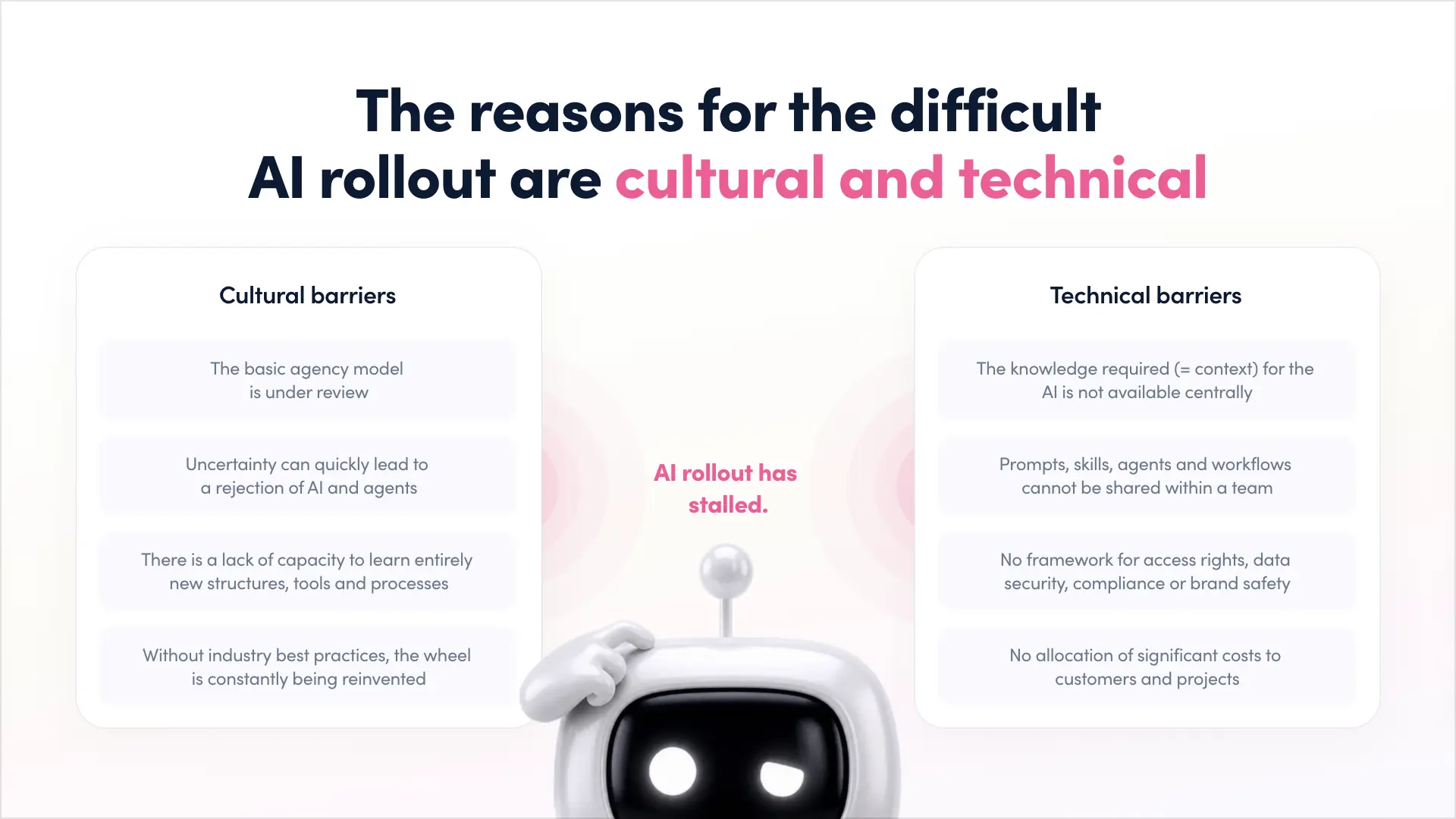
The technical hurdles are overcome relatively quickly. You’ll find an overview of the necessary tools and/or workflows below (jump to the ‘Tools’ section).
The cultural hurdles are particularly important. These are not as easy to overcome as technical hurdles. Here, it is particularly important to support teams that still feel uncertain about working with AI, so that they no longer view these AI tools as obstacles, but as enablers for better day-to-day work processes.
Knowledge sharing, training sessions and transparent communication with the team can gradually help these hurdles to disappear. This is how you pave the way for your AI roll-out.
What is the goal? The agentic agency
You now have a rough idea of where you stand. The goal is to become an agent-driven agency. But just like laying turf in a stadium: you can’t simply lay a huge sheet of turf over everything and expect it all to lie perfectly. We’re taking this step by step. 😉
The agent-driven agency: Individual staff members who are constantly reinventing AI come together to form an agency that uses AI collaboratively. With a shared context, the right tools and specialised agents. The aim: for everyone to be able to focus more productively on the actual value creation.
From phase to phase
Phase 1: Generic AI use
Status: Individual users employ a general-purpose AI chat tool for day-to-day tasks – writing texts, researching, analysing, evaluating data, brainstorming, writing code. Everyone works on their own, independently. The benefits are immediate, but none of this is shared or reproducible.
This is how you move on to Phase 2: as soon as people start sharing their best prompts, tool tips and results with one another, rather than keeping them to themselves. This requires a space where results can be compared and shared.
Phase 2: Verbal best practices
Status: The team discusses AI – verbal tool recommendations, inspiring use cases, plenty of experimentation, and a relaxed exchange of experiences. Real progress, but the knowledge resides in people’s heads and chat threads rather than within a structured framework.
👉 This is where most agencies are at.
Here’s how to move to Phase 3: by centralising that scattered knowledge – bringing together agency, client, brand and project context in one place that the AI can access. Shared ‘word of mouth’ then becomes a shared knowledge structure.
Phase 3: Agency Knowledge
Status: Several AI tools are working with your agency’s centralised knowledge. The context is shared as follows:
- Agency context: Processes & guides
- Client context: Rates, people
- Brand context: Design, tone of voice
- Project context: Briefing, timing
This makes results relevant rather than generic.
This is how you reach Phase 4: when the AI not only understands this context but also acts on it within your tools – connected to your (industry-specific) software via MCP and interfaces.
Phase 4: Agency Tools
Status: Assistants are now carrying out actions within your systems. The AI is no longer just talking – it’s taking action.
For example:
- retrieving data from the CRM
- calculating a quote in the ERP
- creating and planning a project in the PM system
- creating tasks
- informing the team via Slack
This is how you move on to Phase 5: When individual actions become reusable agents – knowledge, tools and processes bundled together, developed within the agency and shared across the team. This requires model-independent AI infrastructure, clear access rights and context awareness.
Phase 5: Specialised Agents
Status: The agency builds its own agents for specific tasks and shares them within the team. Each agent bundles context, tools and processes:
- Research Agent
- Brand Safety Agent
- Briefing Agent
- Costing Agent
How to reach Phase 6: When these agents no longer work individually, but collaborate – in complex workflows spanning multiple disciplines, orchestrated by the team.
Phase 6: The Agent-Driven Agency
Status: People orchestrate, agents execute. Several agents work together on complex workflows across different disciplines. Users make the decisions, agents act accordingly, and the team can create and execute workflows independently.
Behind this lies a simple principle: staff do not constantly have to reinvent AI. The agency provides the knowledge structure (= context), tools and agents – so that everyone can focus more productively on the actual value creation.
The tools required for each phase
All the tools required for these six phases are part of awork. This means you can build your AI readiness using a single platform rather than a patchwork of individual tools.
Conclusion
As an ‘agent-driven’ agency, you can look forward to streamlined processes, faster workflows and a focus on creative and strategic value creation. Along the way, you’ll continually discover new things and move from one phase to the next. Some phases will be easier, whilst others may be a little more labour-intensive.