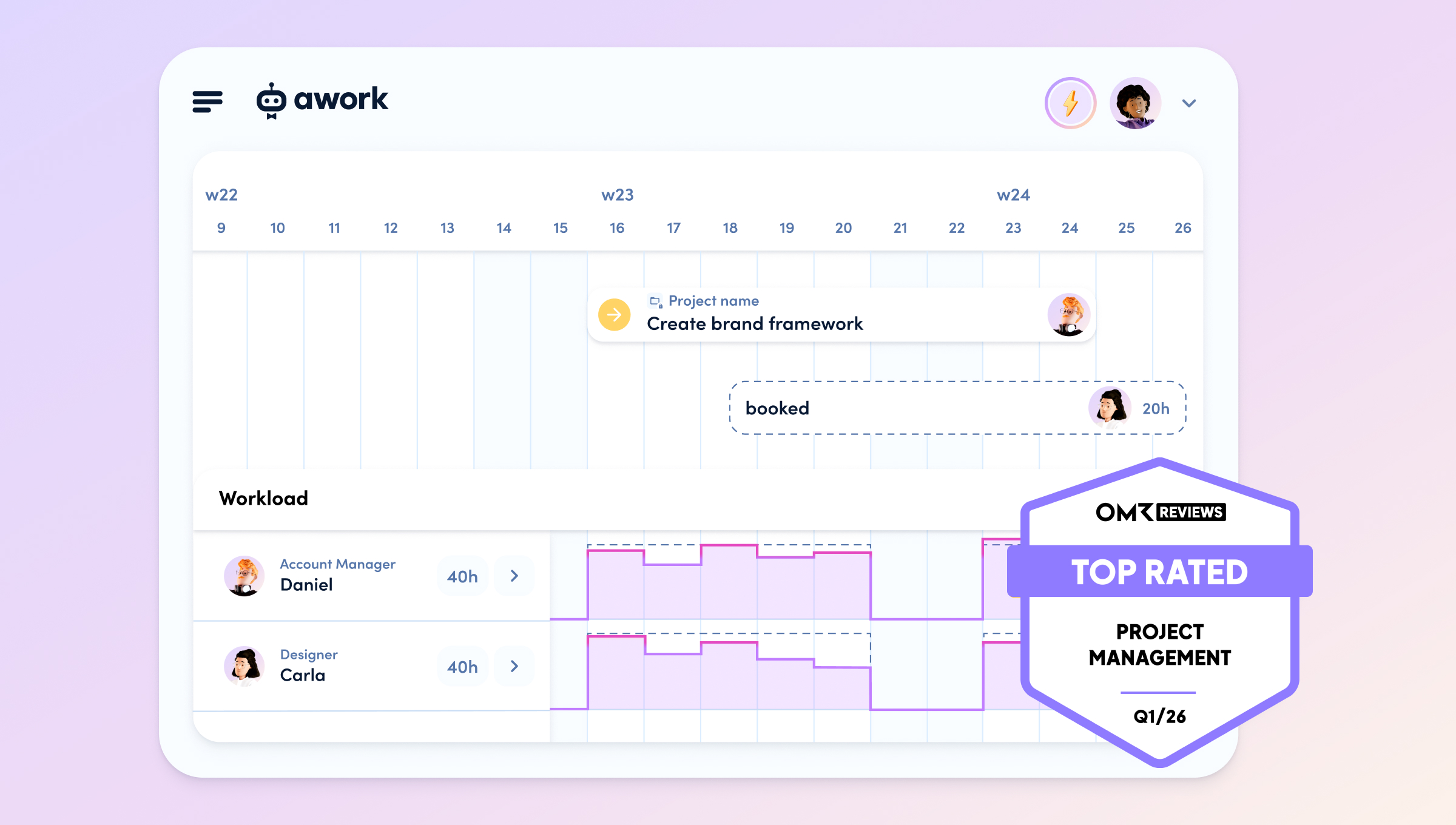
Do your teams also know the notorious Friday request shortly before the end of the day? When projects fly in spontaneously and nobody knows who still has a buffer, resource planning quickly starts to falter. This is where the utilisation rate comes into play. It is the decisive key figure for measuring the actual workload of your agency and ensuring that your team works profitably, but without permanent overload.
The utilisation rate describes the ratio between the time spent directly on billable client projects (billable hours) and the total available working time. When you manage your agency's workload precisely, you don't just plan projects reliably, but also keep an eye on your team's real availability in real time.
Contractual time is not project time: The calculation
In theory, it sounds simple: a team member has a 40-hour week, so 40 hours can be planned for projects. The reality, however, looks completely different. Team meetings, internal coordination, non-billable hours, and absences eat up a large part of the working time.
The basic formula for calculating the rate is:
(Billable hours ÷ Available hours) × 100 = Utilisation rate (%)
If someone works 30 hours per week on client projects and 40 hours are contractually available, the rate is 75%.
Why 100% utilisation is a trap
A common mistake in everyday agency life is the attempt to fully schedule every free minute. However, those who utilise their team at 100% are booking burnout at the same time. Such a high rate means that there is absolutely no buffer for unforeseen coordination rounds, juggling client feedback, or internal further training. A healthy target value for productive team members is usually between 75% and 85% for the industry.
This is why agencies must manage workload strategically
A realistic view of the workload makes the difference between constant chaos and a smooth process. Consciously managing your utilisation rate brings you tangible advantages:
- Prevention of overload: You recognise bottlenecks before they become a threat to your team's mental health or project deadlines.
- Better resource planning: Spontaneous requests are easier to distribute when, thanks to smart capacity planning, you can immediately see who actually has free slots left.
- Economic efficiency: You know exactly how much revenue your team can potentially generate and uncover hidden idle time (under-utilisation).
- Higher Work Happiness: Transparency creates trust. When tasks are distributed realistically, satisfaction and motivation in agencies increase significantly.
Best Practices: First steps towards optimal utilisation
To ensure you no longer have to guess how much time your team really has, three simple basic rules will help you:
- Determine real availability: Always consistently deduct holidays, bank holidays, and fixed internal agency appointments from the contractual working time.
- Block tasks directly in schedules: Connect your project planning directly with your employees' calendars. With an intelligent two-way calendar sync, you secure work blocks firmly in the daily routine.
- Use time tracking as a basis: Booking times accurately is not about control, but rather the essential foundation for making increasingly realistic estimates for future client orders.
FAQ: Frequently asked questions about the utilisation rate
What is the difference between utilisation and productivity?
The utilisation rate measures purely quantitatively how much of the available time is used for defined, usually billable agency tasks. Productivity, on the other hand, measures the output: how valuable, error-free, or efficient was the work that was actually performed during this time?
How often should workload be checked in the team?
Ideally on a weekly basis. A short capacity check-in helps project managers identify deviations in good time and redistribute tasks flexibly in the event of sudden bottlenecks before stress arises.
Do internal agency projects count towards the utilisation rate?
This depends on your team's definition. Mostly, the classic utilisation rate (billable utilisation rate) refers strictly to paid client work. Internal projects lower this specific rate on paper, but are indispensable for innovation, acquisition, and agency growth.
Are you ready to put an end to capacity guesswork and plan projects reliably? Discover how awork helps you with team scheduling and secure workload planning.
[.b-button-primary]Capacity planning with awork[.b-button-primary]