.webp)
No two days are alike in agencies, and that is precisely what makes precise planning so challenging.
Unexpected changes, shifting requirements and tight deadlines not only cost nerves, but also productivity and ultimately profitability.
So how can teams remain capable of acting even under pressure? How can capacity utilisation and resources be planned more effectively?
This is exactly where agile project management comes in, and with the right tool, it becomes a real lever for more profitable agency work.
[.b-button-primary] Curious? Try awork for free! [.b-button-primary]
What is agile project management?
Agile project management originated in IT and software development, but has long since found its way into the agency world – and for good reason. Instead of planning everything down to the last detail in advance, the team works in short cycles, known as sprints, e.g. using the Scrum method.
Agile methods such as Kanban or design thinking help to structure projects flexibly, identify bottlenecks and develop solutions iteratively – without wasting time.
What does this mean for agencies? More flexibility, better capacity utilisation and a workflow that adapts to reality, not the other way around.
Agile projects have long been part of everyday life in agencies: for example, when building websites, developing campaigns or in the pitch process. Effective capacity planning is crucial in order to efficiently cushion short-term changes or new requirements.
Agile project management = flexibility + predictability
Agile projects offer the advantage of combining perfectly with smart capacity planning. Sprints provide structure, while a transparent availability overview ensures that the right people are available at the right time – without overload.
[.b-important-block]A creative team is working on brand development. Instead of planning the entire project in one big push, they work in two-week sprints: in sprint 1, the first mood boards and claims are created. In sprint 2, the chosen concept is developed, followed by visuals and applications in sprint 3. Team members are only scheduled for the phases in which their skills are required – this keeps the workload balanced and the project flexible and manageable.[.b-important-block]
[$tag]💡 Example[$tag]
Advantages of agile project management in agencies:
[.toc-name]Advantages of agile pm[.toc-name]
👉 Better utilisation: through realistic capacity planning based on availability and skills
👉 Higher billability: through accurate time tracking and early control of projects that are getting out of hand
👉 Faster response: to customer feedback without everything falling apart.
👉 Less meeting overload: thanks to centralised communication and task coordination.
👉 Transparency within the team: everyone has access to project status information, reducing misunderstandings.
👉 Regular customer feedback: to ensure that the project meets expectations.
👉 Faster results: if you work in short sprints, you will see interim results more quickly.
👉 Identify risks early: you can spot problems in good time and iron them out early on.
👉 Happy teams: thanks to realistic planning and less stress
Traditional vs. agile project management:
what's the difference?
[.toc-name]Traditional vs. agile pm[.toc-name]

Imagine a road trip. 🚗
With classic project management (e.g. the waterfall method), you plan every step in advance: route, stops, hotels – everything is fixed. There is no room for spontaneous changes.
Agile project management, on the other hand, means that you know where you want to go, but you remain open to new routes.
You stop regularly to check whether you are still on course and adjust your planning flexibly. This allows you to discover more, avoid mishaps – and still reach your destination.
[.b-important-block]Agile project management is not only more flexible in agencies – it is also more profitable: less rework, better capacity planning, more satisfied customers.[.b-important-block]
[$tag]💸 Increase Profitability[$tag]
[.b-button-primary] Try awork for free [.b-button-primary]
5 examples of agile project management
[.toc-name]Examples[.toc-name]
Let's take a look at some examples of where agile project management is frequently used:
- Website relaunch with sprints
A web project is divided into three sprints: concept & wireframes, design & content, development & testing. This allows the design team to work creatively in sprint 1, while the DEV team gets started in sprint 3. This avoids downtime and improves capacity utilisation. - Creative campaign with iterative idea rounds
An agency team develops a cross-media campaign. In week 1, three initial ideas are tested. In week 2, the best idea is refined and transferred into assets. Customer feedback is incorporated directly, preventing costly correction loops shortly before launch. - Agile retainer projects in social media management
Instead of rigid monthly plans, a social media team works with weekly task packages. Content is created, tested and adjusted as needed in short sprints. The team can respond better to trends and performance – without disrupting planning. - Pitch process with flexible resource allocation
A new customer pitch is coming up. Instead of blocking all resources immediately, an initial concept phase is scheduled with a small team. If the pitch becomes concrete, additional resources are planned at short notice – based on actual availability. - Branding projects with rolling collaboration
In a branding project, copywriters, designers and strategists do not work simultaneously, but in phases. While the text is being written, the design team is not yet committed – this allows for more flexibility for parallel projects.

[.no-toc]Does agile working fit your challenges?[.no-toc]
A project manager's daily life is filled with challenges. If you're familiar with the following surprises, agile project management is your perfect match:
- Last-minute changes: The client just wants to "make a quick adjustment," but it has a ripple effect. With agile methods, you can react flexibly without throwing your entire team off track.
- Unclear requirements: Instead of waiting forever for the perfect brief, you develop iteratively—with regular feedback and clear intermediate steps.
- Bottlenecks & overload: Tasks can be flexibly distributed among available team members. This keeps workloads balanced—and deadlines realistic.
- Communication is ineffective: Agile methods ensure greater transparency. Everyone knows what needs to be done—without constant coordination meetings.
[.b-button-primary] Try awork for free [.b-button-primary]
How awork makes agile project management more profitable for agencies
[.toc-name]More profit with awork[.toc-name]
awork is more than just an agile PM tool. It helps agencies manage complex projects efficiently while keeping an eye on utilisation, billability and economic success.
1. Planning across projects, with capacity overview
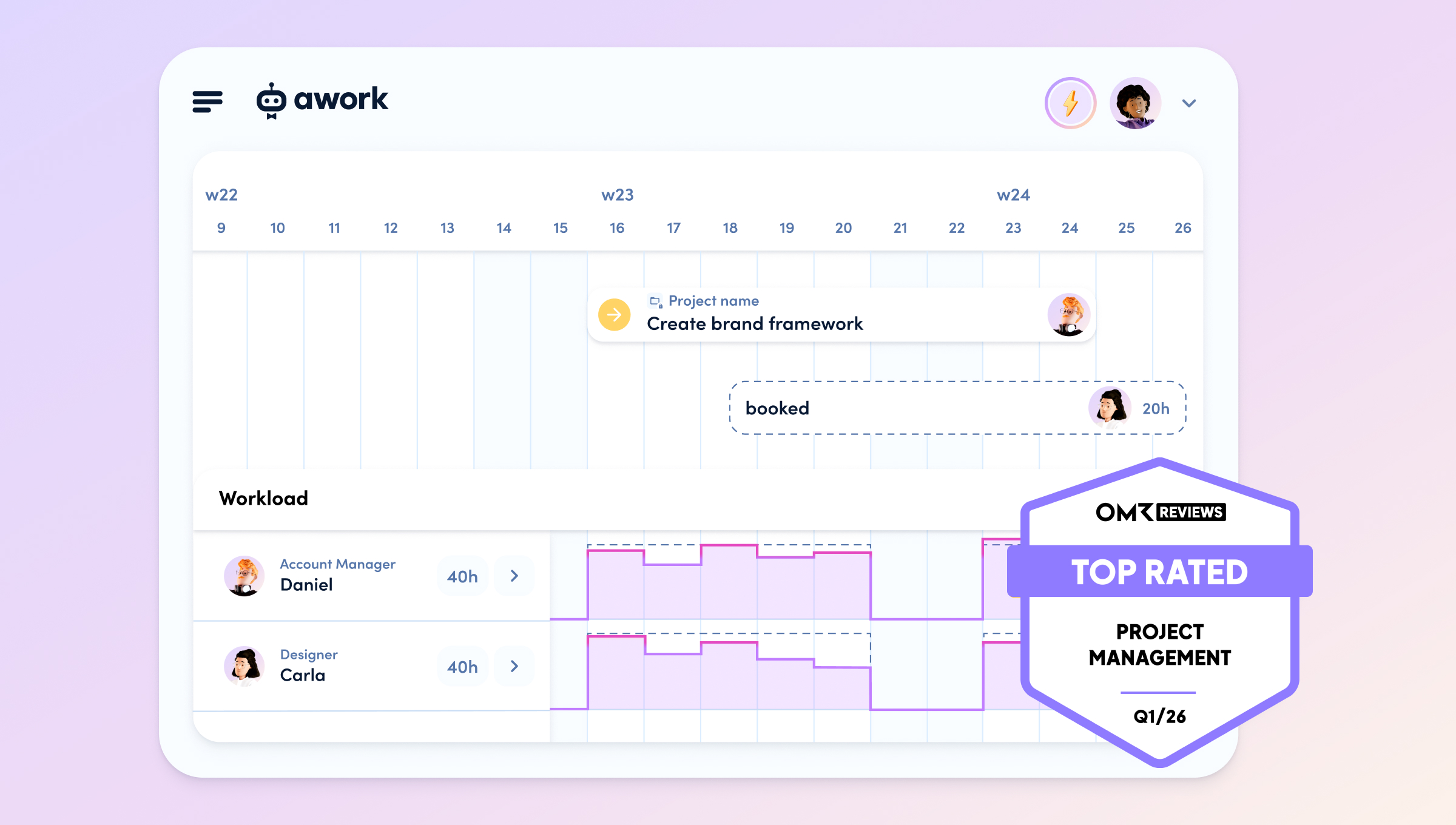
awork shows you at a glance how available your team members are – whether internal or external. Instead of Excel and gut feeling, you use visual capacity planning that makes your projects realistically feasible.
✅ Benefit: On-time results, optimal utilisation, no overload.
More about capacity planning at awork.
Learn how to plan your agency’s utilisation with confidence in our webinar.
2. Assign tasks based on skills and availability
Plan tasks specifically based on skills and availability. awork AI even automatically suggests suitable people for you.
✅ Benefit: Respond flexibly and stress-free, even to last-minute requests.
Discover suitable workflows for your agency in our webinar ‘Improve agency operations with AI’.

3. Seamless collaboration with clients and freelancers
Instead of email chaos and ‘guest access’, awork provides a central location for everyone involved – with comments, updates and clear permissions.
✅ Benefit: Faster approvals, better client communication, no extra tools required.
4. Time and budget always in view
Real-time time tracking and budget reporting: awork shows you which projects are profitable and where you need to take countermeasures.
✅ Benefit: Higher billability, better forecasts, more economical decisions.
More about time tracking with awork.
[.b-testimonial]With so many projects running simultaneously, we need awork because it perfectly adapts to our own workflow.[.b-testimonial]

[.no-toc]You + awork + agile project management methods = 💜[.no-toc]
Do you work in project management at an agency and want to not only deliver your projects, but also manage them effectively, utilise capacity better and make them more profitable? Then awork is your perfect partner.
With awork, you can plan capacities realistically, coordinate your team efficiently and keep track of budgets, tasks and deadlines – all in one place. This turns agile project management into a real business lever: for better team performance, more satisfied customers and measurably greater profitability.
[.b-button-primary] Curious? Try awork for free! [.b-button-primary]