
[.b-important-block]awork handles project planning, resourcing and time tracking; MOCO handles quotes, invoicing and financial controlling. The interface automatically creates a project and tasks in awork from your costing in MOCO, and feeds the time recorded in awork back into MOCO. This does away with manual handovers between sales, delivery and accounting, and you see budget, utilisation and margin in real time.[.b-important-block]
[$tag]💡 Good to know[$tag]
The awork and MOCO integration is a tool interface that connects the project management tool awork with the agency software MOCO.
It creates projects and tasks from MOCO in awork and automatically syncs the recorded time back to MOCO.
👇 Scroll down to the awork x MOCO webinar
You'll know the feeling…
Your projects are running, the team is delivering, but information keeps falling through the cracks between the quote, the time tracking and the invoice. The reflex is often: "We need one tool that can do everything." Sounds tidy. In the reality of agency life, it's usually a trap.
Because an all-in-one system is a little bit good everywhere and properly strong nowhere.
When you build a house, you don't hire one trade to do everything either — you bring in the tilers, the electricians, the structural engineers. Specialists who know their craft and work together cleanly.
That's exactly how awork is conceived, straight out of agency workflows: planning, time tracking, resourcing and external collaboration in one system.
We deliberately leave the commercial side to specialists like MOCO and dock onto them, rather than watering down our specialisation.
Why "all in one" is not the one
In every agency, two worlds work side by side: the operational minds who deliver the projects, and the numbers-driven roles who cost, invoice and steer.
A generic tool forces both into the same logic and ultimately satisfies neither. The creatives wrestle with controlling fields they don't need, and the finance team wrestles with a project management setup that doesn't reflect the reality of your teams.
The clean answer: two specialised tools that interlock.
- awork is the operational home for your teams
- MOCO the commercial home for quotes, invoices and accounting
Both groups keep their own tool, and nobody has to compromise on features.
[.b-testimonial]Good work organisation creates the conditions for teams to enjoy working and to work effectively — putting less energy into planning chaos and more into ideas and collaboration.[.b-testimonial]

Who does what: awork and MOCO
[.toc-name]Who does what[.toc-name]
awork: the project management tool for your agency:
- Multi-project and task management across all client projects
- Task- and project-based time tracking with automated reporting
- Capacity and resource planning in the planner, including calendar sync
- External collaboration via awork Connect: bring in clients and freelancers free of charge and without limits
MOCO: the agency software for the commercial side:
- Quotes and costing (estimates) with a service catalogue and templates
- Invoicing, dunning and payment reconciliation
- Accounting export, e.g. to DATEV
- Project and financial controlling down to client level
How the shared workflow runs
Agency tool stack with MOCO and awork for agency project management and agency invoicing with MOCO.
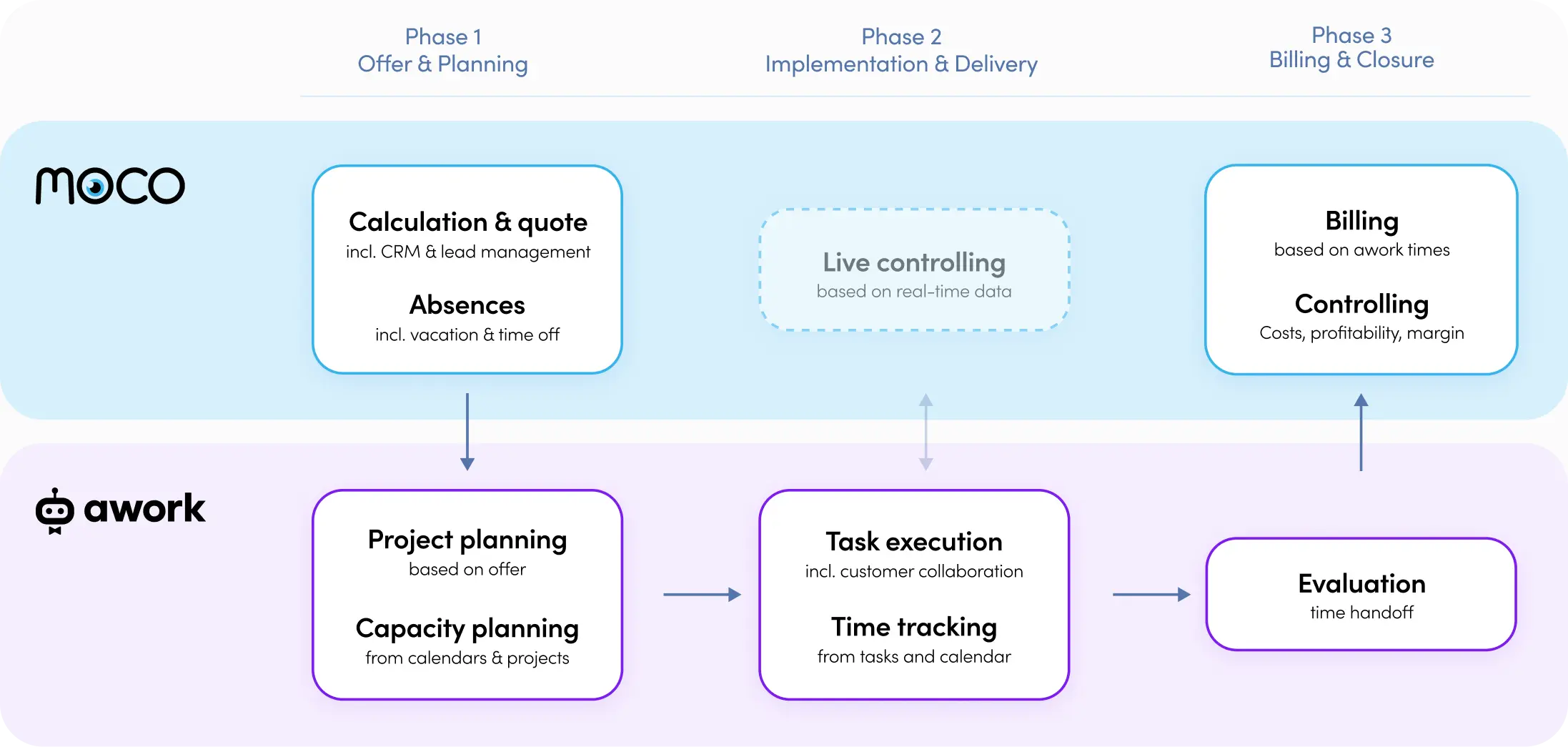
- Costing in MOCO: You create the quote, the client confirms via e-signature, and that becomes the project.
- Sync to awork: awork pulls in the key data — client, start and end date — and the service line items from the estimate are created as tasks. Absences from MOCO also feed into resource planning.
- Operations in awork: Your teams plan tasks, record time, manage utilisation and collaborate with external partners. Using templates, you decide how a project arrives already structured when it syncs.
- Time back to MOCO: The hours recorded in awork flow into MOCO and become the basis for invoicing there.
- Invoicing and controlling in MOCO: The time becomes the invoice, and you see in real time how profitable the project really is.
What this means for utilisation and profitability 💸
[.toc-name]Utilisation and profitability[.toc-name]
This is where the combination pays off most. Utilisation planning is directly linked to revenue, profitability and billability: staff costs are fixed, and what matters is how much capacity lands on billable projects.
When the planned hours sit in awork, the recorded time flows back, and MOCO calculates profitability from it, you're working with live data throughout — instead of an out-of-date Excel doc.
For leadership, management and team leads, that means: you can see across multiple teams and parallel projects who is utilised and by how much, what's still within budget, and where you need to steer early. Exactly the visibility that decides profitability.
Who this setup is worth it for
For agencies that want to get out of gut-feel mode and steer their projects across multiple teams, client budgets and external contributors. The creatives stay in operational awork, the commercial roles in MOCO, and both worlds share the same data basis without slowing each other down.
In this webinar, Dennis from MOCO and Seyer from awork show you how to connect your agency tools.
Ready to give it a try? 🫶
[.b-button-primary]Start a free trial[.b-button-primary]