A forecast (or prediction) in an agency context is far more than staring into a crystal ball. It is the fundamental tool for making reliable statements about the future based on historical data and current developments. Instead of basing projects and budgets on mere "gut feeling", a clean forecast allows you to identify bottlenecks in capacity planning early on and minimise financial risks.
Definition: What is a forecast?
A forecast is a data-driven estimate of future events. In agencies and project-based teams, this usually refers to:
- Finances: What revenue will we (likely) generate in the coming months?
- Resources: How busy is the team? Do we need freelancers or can we take on new projects?
- Projects: Will we be able to meet the milestones at our current pace?
In contrast to a static annual budget, which is often created once, a good forecast is dynamic. It is updated regularly – often monthly or quarterly ("rolling forecast") – to adapt to the volatile reality of the agency business.
Why agencies fly blind without a forecast
The project business is fast-paced. A client pulls out, a pitch is unexpectedly won, or a project drags on longer than planned. Without a forecast, you only react to these events when it is often too late. A forecast allows you to act:
- Avoiding "feast or famine": Recognise revenue gaps in three months' time today and manage sales accordingly.
- Better personnel planning: See exactly when your design team will be overloaded before burnout looms.
- Secure liquidity: Know exactly when invoices are likely to be issued and paid.
The 4 levels of an agency forecast
A complete forecast looks not only at money, but at the connections between projects and people. We divide this into four levels:
1. The Revenue Forecast
Here you analyse not only booked orders but weight your sales pipeline. A proposal for £50,000 with an 80% probability of closing is factored into the planning differently than a vague lead.
2. The Resource Forecast
Does your team have the necessary skills and hours for upcoming tasks? Important note: never plan for 100% availability. Illness, holidays, and internal organisational work reduce actual project time. A tool for project management like awork helps you to compare actual net capacity against planned effort.
3. The Project Forecast
This forecast looks at the progress of ongoing projects. Based on the current pace (velocity) and remaining tasks: Will we stay within budget? Does the go-live date remain realistic?
4. The Utilisation Forecast
This answers the question: Who is doing what and when? While the resource forecast checks capacities somewhat abstractly (e.g. "We have 100 developer hours"), the utilisation forecast checks the specific distribution across individuals to avoid over- or under-utilisation.
[.b-related-article]Mastering resource planning in agencies[.b-related-article]
Best practices for accurate predictions
To ensure your forecast doesn't become a theoretical exercise, follow these tips:
- Ensure data quality: A forecast is only as good as the underlying data. Ensure that time tracking and project statuses are kept up to date by the team.
- Rolling planning: Instead of stubbornly sticking to the plan from January, update your forecast monthly for the next 12 months.
- Create scenarios: Work with best-case, worst-case, and real-case scenarios to be prepared for surprises.
- Honesty over wishful thinking: A forecast should reflect reality, not the hopes of management. If a project is shaky, this must be visible in the forecast.
Creating a forecast with awork
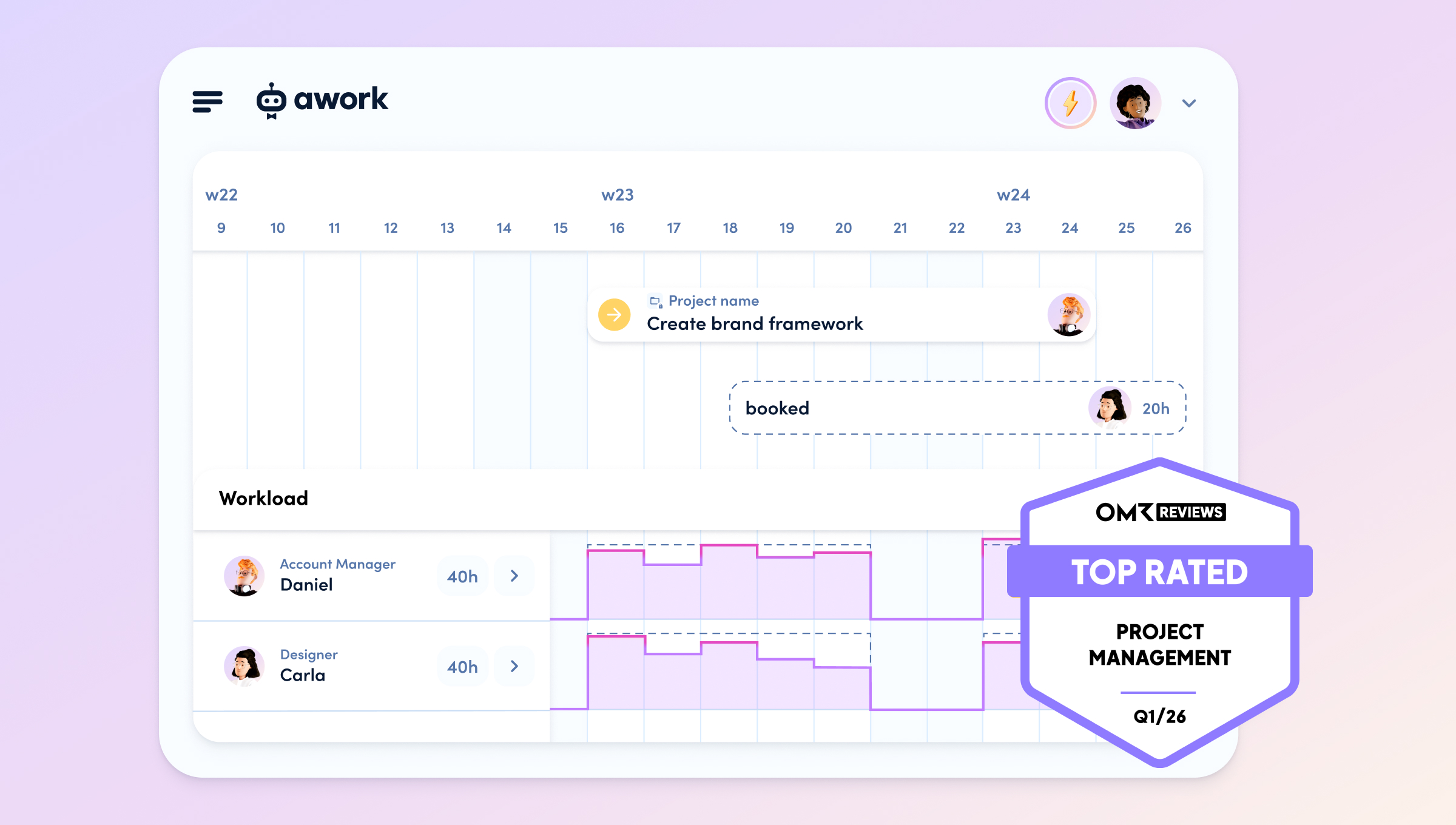
Modern agency software takes a lot of manual work off your hands. In awork, planning and actual data flow together directly. The utilisation overview visually shows you where bottlenecks are looming in the coming weeks, based on the planned tasks and calendar entries of your team. In this way, the forecast turns from an annoying Excel sheet into a daily management instrument.
FAQ
What is the difference between budget and forecast?
The budget is the plan you set (usually annually) – it is the target you want to reach. The forecast is the regular review of where you will actually land, based on current data. The budget is static (goal setting), the forecast is dynamic (reality check).
How often should I create a forecast?
A monthly rhythm is recommended for agencies. For very short project durations, a bi-weekly check-in within agile project management can even be useful.
What data do I need for a good forecast?
You need historical data (how long do projects typically take?), current project data (status, remaining effort), and pipeline data (what new orders are likely to come in?).
[.no-toc]Conclusion[.no-toc]
A reliable forecast is the key to stability and growth for agencies. It transforms uncertainty into predictability and helps you to lead your team profitabily and without stress. Start small by first digitising your resource planning and build your revenue forecasts on top of that.