.webp)


Whether it's a blog, website or social media, your channels need fresh content on a regular basis. The key to this? A well-thought-out content plan. It helps you work efficiently, achieve your goals and publish content in the right place at the right time.
In this guide, we'll show you why a content plan is so important, how to set one up and how to use it to work smarter and with less stress – with our content plan template, of course. Ready? Let's plan!
[.b-button-primary]Start content planning[.b-button-primary]
What is a Content Plan?
In agencies, a content plan is much more than just an internal tool; it is the central control instrument for planning, creating and publishing content for your customers. A well-thought-out plan covers all phases of content production: from brainstorming and creation to publication and performance analysis.
A good content plan helps you to efficiently coordinate different customer requirements, deadlines and distribution channels across teams. At the same time, it becomes the single source of truth for everyone involved: whether project management, creation or customer, everyone is always in the picture. This ensures clear processes, less coordination effort and more room for creative excellence.
What are the benefits of a Content Plan?
A clearly structured content plan in project management helps to manage customer projects efficiently, transparently and profitably.
- You deliver consistent output for different customers.
With a clear plan, you ensure that all content for your customers is published regularly, coordinated and on time, without any last-minute stress. - You increase your efficiency and utilisation
Centralised planning and capacity overview allow you to make optimal use of resources. This reduces idle time, increases productivity and improves your billability. - You plan strategically and purposefully
Whether it's reach, leads or brand building, you can tailor content to customer and campaign goals and make it measurably more successful. - You work transparently and across teams
All project participants – internal and external – have access to the planning status. This reduces coordination effort, promotes collaboration and increases customer satisfaction. - You remain flexible and adaptable
Trends change, and so do customer wishes. With a dynamic content plan, you can react at any time and reprioritise content without losing sight of the big picture.
These advantages not only bring order to your agency's daily routine, but also lay the foundation for economically successful customer projects. And best of all, with the right tool like awork, planning becomes not only easier, but also measurably more profitable.
[.b-button-primary]Start content planning[.b-button-primary]
How to create a Content Plan?
To create your content plan, one thing is crucial: don't panic! It sounds more overwhelming than it is, promise. With a structured approach and the right tools, it becomes a breeze. Here is a step-by-step guide based on our awork template:
[.b-button-primary]Start content planning[.b-button-primary]
Step 1: Develop a content strategy
Define clear project goals:
What should your clients' content achieve? Whether it's reach building, lead generation or conversion optimisation, set specific, measurable goals at the beginning of each campaign. These form the basis for your strategic planning and help you align the content with your target group's customer journey.
Target group analysis is a must:
Who consumes your customer's content and why? Develop data-based personas to create content that is truly relevant. The better you understand the needs of your target group, the more precisely you can plan, distribute and optimise content and convince your customers with measurable results.
Conduct a content audit:
Whether for new clients or existing projects: analyse the existing content.
- What performs well?
- What can be removed?
- Where are the gaps?
A thorough audit forms the basis for a targeted strategy and saves you and your clients unnecessary production costs.
Step 2: Plan content creation
Research trends and topics in a targeted manner:
Agencies in particular are under pressure to shine with relevant and up-to-date content. Use tools to identify topics that really have potential and align them with your client's communication goals. SEO, target group interest and timing should always work together.
Think about distribution from the outset:
Whether it's Instagram, newsletters, blogs or LinkedIn, the best content is useless if it doesn't appear on the right channel at the right time. Plan where and how the content will be played out during the conception phase and keep track of all channels centrally in your editorial plan.
Structure your editorial plan:
Create a clear editorial plan for each client or campaign. Clearly define deadlines, responsibilities and priorities. This allows you to manage multiple projects in parallel without falling into chaos. In awork, the plan becomes the central control document for your entire team.
Maintain an ideas backlog:
Creative ideas often bubble up in between other tasks. Give them a permanent place. With a well-maintained ideas backlog, you'll always have content ideas ready when a slot becomes available. At the same time, your editorial plan remains focused on what really matters right now.
[.b-button-primary]Start content planning[.b-button-primary]
Step 3: Plan resources
Assign roles and capacities:
In agencies, time is money, and good planning determines the profitability of a project. Assign a responsible person to each piece of content and plan based on the actual availability of your team members and freelancers. With awork, you can see at a glance who has capacity when and assign tasks accordingly. This reduces bottlenecks, avoids overload and ensures optimal utilisation of your team's capacity.
Use briefing templates:
Standardised briefings are the key to smooth implementation, especially when multiple stakeholders, external partners or freelancers are involved. Create structured templates for different content formats to avoid misunderstandings and maintain high quality. Clearly defined tasks save time and increase customer satisfaction.
Create transparency for all involved:
In agencies in particular, several teams often work on the same customer project or there are frequent changes. A neatly maintained content plan in awork ensures that everyone involved is on the same page at all times, even if responsibilities change or new team members join.
[.b-button-primary]Start content planning[.b-button-primary]
Step 4: Analysing and optimising content
Analyse performance:
After go-live is before the next content sprint. Use performance data to evaluate which content really delivers results for your customers. Whether it's traffic, engagement or leads – define clear KPIs and give your customers regular insight into the results. This not only increases transparency, but also provides concrete arguments for follow-up projects.
Gather targeted feedback:
Collect structured feedback, both from the target group (e.g. via social listening or customer surveys) and internally within the team.
- What went well?
- Where were there coordination problems?
- Which formats work particularly efficiently?
This not only improves the quality of your content, but also your internal workflows, which has a direct impact on your profitability.
Transfer learnings to the next planning phase:
Document your findings and actively use them for the next content cycle. In awork, you can analyse and archive completed tasks and use them to build a knowledge base for future campaigns. This saves time, improves strategic planning and ensures continuous development, both internally and in customer relationships.
[.b-button-primary]Start content planning[.b-button-primary]
Content Plan Example: How to successfully implement your Content Plan
This is your official invitation: We take you through our own content planning! For this, we use our content plan template in awork, as all important points for planning are already predefined here, and our editorial plan – the heart of the content plan – lives here.
Organising our content plan in awork becomes an absolute game-changer once we move into the active part of creation. We stay up-to-date on deadlines and priorities at all times and can also transparently show other teams what we are currently working on in the content team.
[.b-button-primary]Try the template now[.b-button-primary]
Project Kick-off: Planning the strategy
At the start of each quarter, we initiate a new project using the content plan template. In the project's list view, we find the key tasks for our planning. We begin with the "Content Strategy" list and define our goals to be achieved by the end of the quarter.

Tip: We enter the goals into the checklist instead of the sub-tasks of the respective task to keep them visible even after they are achieved and checked off.
Assigning responsibilities and deadlines
"What everyone could do often remains undone." Knowing this, each task in our content plan is assigned a single responsible person. It doesn't matter if the entire team is involved in the end; what's important is that one person holds the responsibility.
To ensure the planning doesn't drag on indefinitely, we set a milestone "Editorial Plan Kick-off" by which the initial planning topics should be completed. We adjust the task deadlines accordingly and use the timeline view to keep the milestone in sight.

Preparing the editorial plan
After the content strategy, we focus on the core: our editorial plan! The awork template already includes an editorial plan template in the form of a list. Every content piece identified through our content audit and brainstorming, which we plan to publish in the coming quarter, is added to this list.

Planning capacities
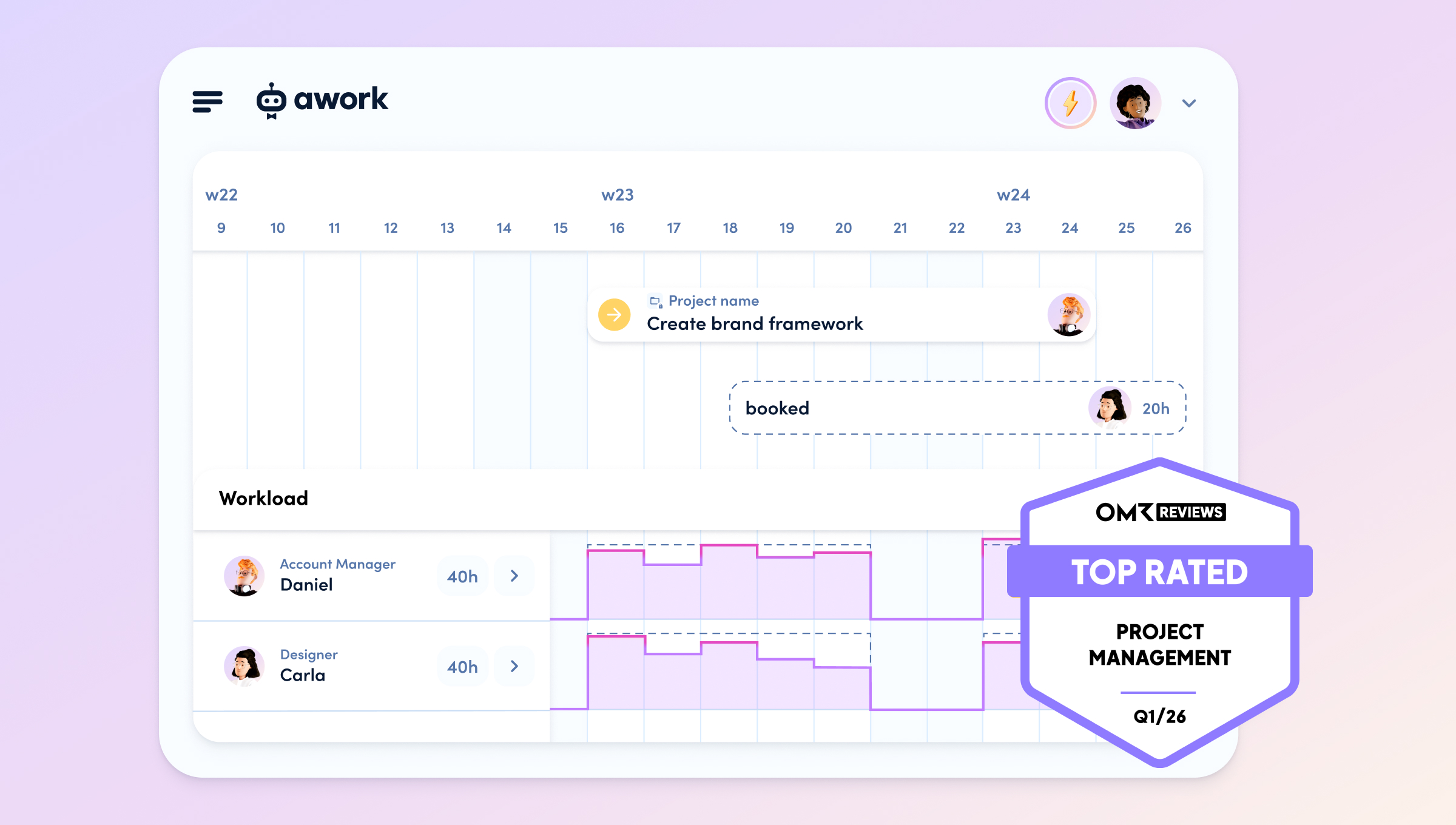
Our planned content pieces indicate who is needed for creation. In the awork planner, we view team members' workloads and assign tasks accordingly. The workload automatically adjusts once someone is booked for a content piece.

Creating the editorial plan
Our editorial plan thrives on assigning status and important information to content pieces. We work in the Kanban view and categorise tasks into different statuses:
🔵 Next up
🟡 In Progress
🟣 In Review
🔴 In Implementation
🟢 Done
This categorisation is particularly helpful in the Kanban view. We filter by lists, collapse all lists except the editorial plan, and everything becomes neatly organised for perfect coordination in daily content management.

Assigning content properties
Each task is assigned properties such as content format, distribution channel, priority, and goal. These are assigned through custom fields in awork. We use tags sparingly and only for important matters to maintain clarity.
Concluding the content plan
At the end of the quarter, we analyse the success of the content plan. We review tasks in the "Done" status and move them to the "Performance Analysis" task for evaluation. This helps us identify successful content and decide where further optimisation is needed. These insights feed into the upcoming content plan to continuously improve our content strategy.
Conclusion
A well-thought-out content plan is much more than just a nice structure for agencies; it is the basis for profitable, scalable content marketing on behalf of clients. It helps you plan content strategically, use internal resources efficiently and successfully implement your client projects.
The editorial plan in our awork template is particularly valuable: it forms the heart of your planning by organising all content pieces – across different clients, channels and campaigns – centrally and clearly. This ensures that content is published on time, coordinated and in the right format.
Thanks to integrated capacity planning, you always know which team members are available and can manage your workload in a targeted manner – which has a direct impact on your billability and project margin. And with ongoing analysis of your content performance, your strategy stays on track not only creatively, but also economically.
👉 Use our template to professionalise your content planning, streamline your processes and work in a more structured, transparent and profitable way as an agency.