[.b-important-block]awork is an Asana alternative for agencies that don't just need to organise their projects but run them profitably. The key difference: awork is purpose-built for agencies and combines time tracking, budget control and capacity planning natively in one system. Asana is a strong, generic project management tool for cross-functional knowledge work, but it doesn't bring these agency-specific features natively.[.b-important-block]
[$tag]💡 Good to know[$tag]
Asana is one of the most well-known project management tools worldwide – and for good reason. It helps teams organize tasks, map workflows, and collaborate productively.
But for agencies, that's often not enough.
While Asana excels in many industries, agencies quickly hit limitations – especially when billable project work, economic control, and real capacity planning are the focus.
The problem: Asana wasn't specifically developed for agencies. Core functions like time tracking, budget control, or capacity planning are either completely missing or can only be implemented through external tools and complex workarounds.
For agencies that need to not just organize projects but manage them economically, this means: fragmented data, additional tools, limited transparency – and ultimately: lack of control over profitability.
awork takes a different approach: It was specifically developed for agency requirements and unites all central functions for billable project work in one system.
In this article, we compare Asana and awork from an agency perspective:
- Where are the structural differences?
- Which features are truly relevant?
- And when is switching to a specialized tool worthwhile?
[.b-button-primary] Request your personal comparison [.b-button-primary]
Is awork an alternative to Asana?
[.toc-name]awork as Asana alternative[.toc-name]
Yes, awork is perfect for an alternative for agencies.
Asana works well for teams that want to structure tasks and map out workflows. awork becomes the alternative as soon as billable project work, budget control and capacity planning come into play.
The reason lies in how each tool is built:
Asana is designed for cross-functional knowledge work, not for agencies with client projects.
Features like native time tracking, real capacity planning or budget control are either missing in Asana or can only be pieced together via external tools and custom fields.
Typical limitations for agencies:
❌ No native time tracking
❌ Time budgets only mappable via Custom Fields or external tools
❌ Task-based capacity planning, without real availability
❌ Focus on productivity – not on economics
That's why agencies often run a stack of three to five tools. awork bundles these functions into one.
awork was specifically developed for agencies
awork unites all central functions for billable project work – time tracking, budget control, and real capacity planning – in one place. This allows agencies to not only organize their projects but manage them economically.
When is awork the better choice over Asana?
awork is the better fit when several of these points apply to your agency:
✅ Your project work is billable (time = money).
✅ Budgets and schedules need to be kept consistently.
✅ You actively plan and monitor workload and capacity.
✅ Projects should be run profitably – not just organised.
✅ Working with freelancers and clients is part of your daily business.
Asana stays a sensible choice if your focus is purely on task and workflow organisation, and profitability, time tracking and resource management don't play a role.
Asana vs. awork: the key differences
[.toc-name]Differences: Asana vs. awork[.toc-name]
A look at the agency-relevant project management features shows what use case each tool was built for.
::table::
tool comparison | awork | Asana
Agency focus | ✅ Built specifically for agencies | ❌ General-purpose
Time tracking | ✅ Native, planning-integrated | ❌ Not native
Billability tracking | ✅ Real-time, automatic | ❌ Via external tools
Capacity planning | ✅ Real availability planning | ⚠️ Estimate-based workloads
AI context | ✅ Business & operations | ✅ Productivity & workflows
EU server location | ✅ Germany | ⚠️ USA (EU from Enterprise)
Setup | ✅ Agency-ready | ⚠️ Highly configurable
::/table::
[.b-button-primary] Request your personal comparison [.b-button-primary]
How does capacity planning differ in Asana vs. awork?
[.b-important-block]Asana plans capacity based on tasks, awork based on real availability.[.b-important-block]
[$tag]💡 Key difference[$tag]
How capacity planning works in Asana:
Asana shows task-based workloads, meaning how many tasks are assigned to a person or team. It doesn't consider how much time tasks actually require or how many hours are really available.
❌ Limitations for agencies:
- Capacity is based on number or weighting of tasks, not on real working hours
- Working hours, part-time models, and absences are not natively considered
- No connection to tracked time or project budgets
For agencies, this provides rough orientation but no reliable capacity assessment.
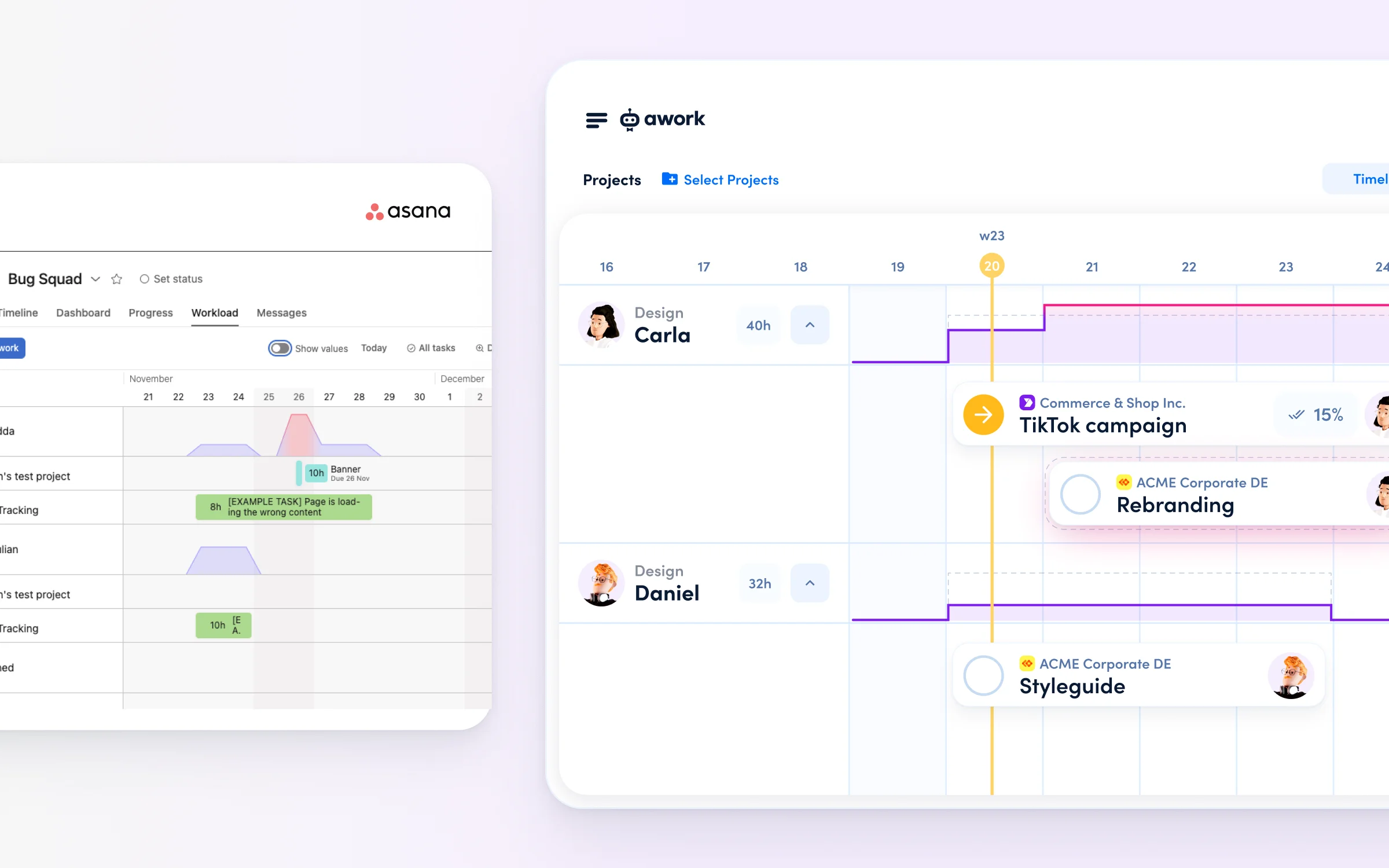
How capacity planning works in awork:
awork works with real availability. Utilization is based on:
- Individual working hours (part-time models, 4-day weeks, etc.)
- Absences (vacations, sick leave, etc.)
- Calendar appointments (meetings, client appointments, workshops, etc.)
- Planned project work
- Already tracked time
Utilization is directly linked to projects, budgets, and time.
✅ Agencies can therefore reliably see in real-time:
- How much capacity is still available
- Whether projects are running economically
- How utilization affects margin and profitability
In short: awork enables reliable utilization and margin management as needed in the agency business.
Learn how to plan your agency’s utilisation with confidence in our webinar.
[.b-button-primary]Test capacity planning in awork[.b-button-primary]
How does time tracking differ in Asana vs. awork?
[.b-important-block]Asana has no native time tracking, awork tracks time directly within the project.[.b-important-block]
[$tag]💡 Key difference[$tag]
How time tracking works in Asana:
Asana offers no native time tracking. Many agencies therefore resort to external tools like Harvest, Toggl, or Everhour.
❌ Limitations for agencies:
- Project planning and time tracking happen in separate systems
- Time data must be synchronized via interfaces
- Budgets and progress are not automatically linked to tracked time
- Additional tool costs and setup effort
How time tracking works in awork:
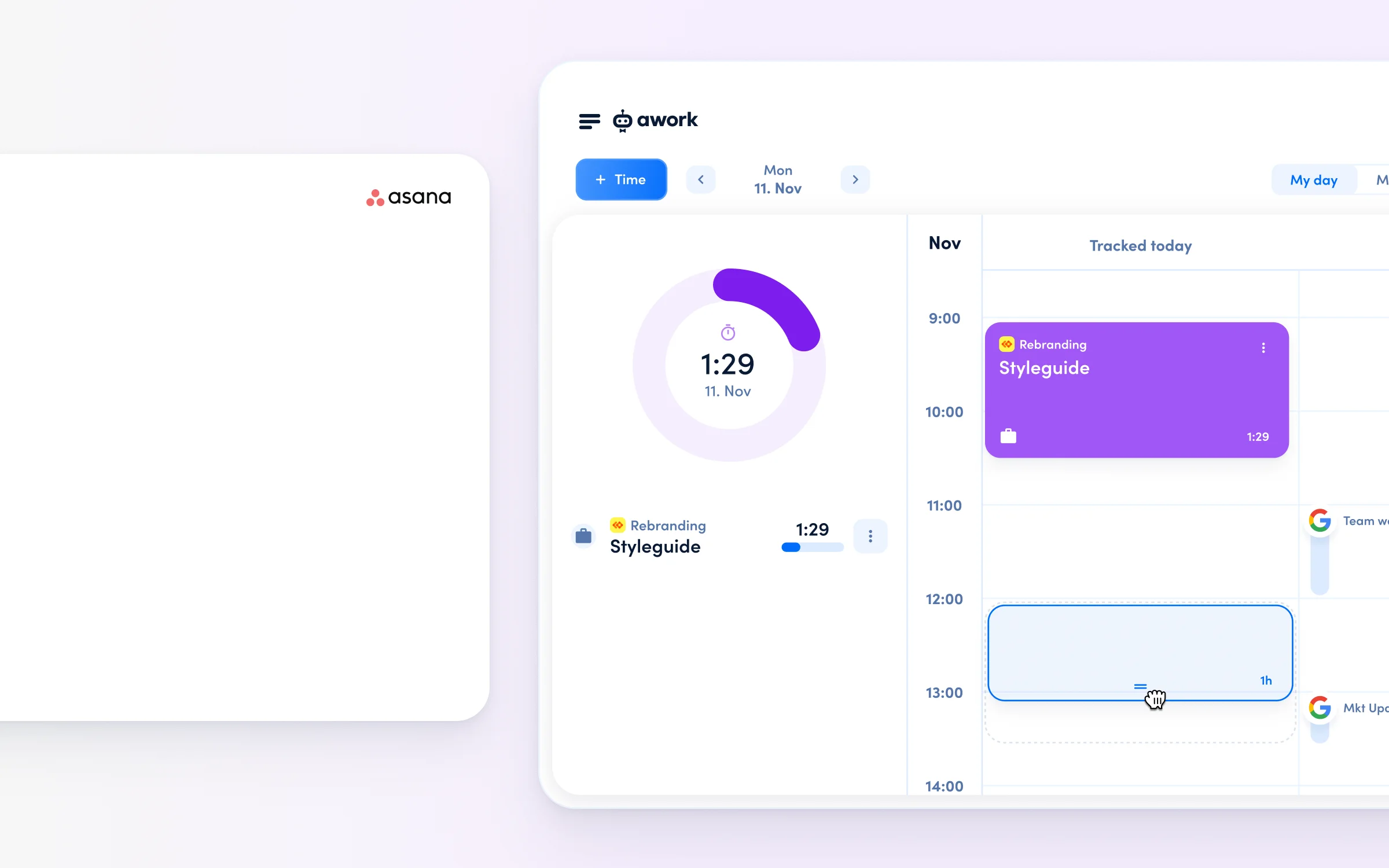
In awork, time tracking is fully and natively integrated into project workflows. Time can be tracked in various ways:
- Via timer
- Drag & drop
- Directly from calendar
- Via browser plugins
- Through AI time tracking
Time is tracked directly on tasks and projects and is automatically linked to budgets, progress, and utilization.
We switched from Asana to awork. The flexibility of awork, from time tracking to task creation, is what I particularly love about it
Michael Schmitt, CEO Storyliner (formerly Sigmund Talks)
✅ Project managers see in real-time:
- How much time has already been consumed
- How much time budget is still available
- How this affects team utilization
In short: awork tracks, plans, and manages billable time as needed for agencies' business model (time = money).
[.b-button-primary]Test time tracking in awork[.b-button-primary]
How does collaboration with external parties differ in Asana vs. awork?
[.b-important-block]Asana brings external people in as guests, awork connects independent workspaces via awork Connect.[.b-important-block]
[$tag]💡 Key difference[$tag]
How it works in Asana:
Asana fundamentally treats external people as guests in your own system. Concretely, this means: External parties receive limited guest roles with restricted access to individual projects – potentially fee-based depending on scope.
❌ Limitations for agencies:
- Collaboration is heavily restricted
- Only scales limitedly once multiple freelancers or clients are involved in parallel
- Additional costs for more extensive guest rights
How it works in awork:
awork follows a fundamentally different approach specifically designed for agency work with freelancers and clients. External parties are not part of the internal system – instead, projects are shared between workspaces via awork Connect.
Agency(ies), freelancers, and clients work simultaneously in the same project structures without one party being a "guest" of the other. A shared project context is created for all participants.
✅ This means concretely:
- Each party works in their own workspace
- Projects are connected across companies
- Collaboration happens at project level – not system level
- Precise permissions determine what's visible
- No additional costs – neither for the agency nor for freelancers or clients
In short: awork reflects how agencies actually work. Collaboration scales without increasing tool costs.
External collaboration in Asana vs. awork
[.b-button-primary]Test awork Connect[.b-button-primary]
AI features: Productivity vs. agency management
[.b-important-block]Both tools offer AI. Asana's AI is built for productivity, awork's AI for running an agency – because it has access to time, budget and workload.[.b-important-block]
[$tag]💡 Key difference[$tag]
How AI works in Asana:
In Asana, AI is particularly focused on productivity and process support.
Typical features:
- Smart Status: Automatic generation of project status updates
- Smart Summaries: Summaries of tasks, comments, and project progressions
- Smart Goals: Support in formulating and prioritizing goals
- Text support: Optimizing task descriptions, meeting notes, comments
❌ Limitations for agencies:
Since agency-relevant data like tracked time, utilization, and project budgets are not natively linked, the AI lacks access to economic control data.
How AI works in awork:
In awork, all relevant information comes together – including:
- Projects and tasks
- Tracked time and time budgets
- Real availability and utilization
- Calendar and absence data
- Briefings and internal documentation via awork Docs
This allows awork AI to address exactly where the greatest business impact occurs: in holistic project and resource management.
The integrated AI understands the full context of agency work in real-time – and actively implements tasks in awork.
✅ Typical use cases:
- Automatic resource allocation based on real availability
- Rescheduling in case of absences or spontaneous requests
- Project planning considering utilization and time budgets
- Automatic reports on project profitability and team utilization
In short: Both tools offer comprehensive AI features. The crucial difference lies in the context the AI can access – and thus the type of support it can offer agencies.
Discover suitable workflows for your agency in our webinar ‘Improve agency operations with AI’.
In summary: The biggest advantages of awork for agencies
[.toc-name]Advantages of awork[.toc-name]
Agencies work project-based and under economic pressure. What matters is therefore not only what gets done, but also how profitably projects run. awork focuses precisely on these business KPIs:
1. Economic project control in real-time
awork shows at any time how much time budget has already been consumed on a project or client – and how much is still available. Project managers can identify budget risks early (also with help from awork AI) and take corrective action before projects become unprofitable. Not just in monthly reporting.
Thanks to awork, we have a better billing rate through the recording and transparency of internal and external hours.
Nicole Hölscher, CEO Kreativ Konzept
2. Real capacity planning instead of task lists
awork doesn't plan capacity based on tasks, but on real availability: Working hours, absences, calendar appointments, and already tracked time flow in automatically. Agencies can see whether teams are realistically over- or underutilized – not just how many tasks are open.
3. Time, budget, and utilization in one system
While many tools treat time tracking, budgets, and resource planning separately, these functions are natively linked in awork. This saves setup effort, avoids data silos, and enables informed decisions based on consistent real-time data.
4. Transparency for all stakeholders
awork makes project status, progress, and utilization visible to all relevant roles without manual data compilation or exports. External participants can be natively integrated into projects. This creates clarity in the team, with clients, and in management.
5. Services focused on agencies
awork's UX is designed for creatives who value intuitive and beautiful UIs. The support and onboarding services are also tailored to this use case and common agency best practices.

Frequently asked questions about Asana alternatives
[.toc-name]FAQ about Asana alternatives[.toc-name]
Is awork more secure than Asana?
Both tools are GDPR-compliant, but they differ on hosting and EU data residency.
- awork is a German company and hosts exclusively on servers in Germany (Frankfurt). GDPR compliance and ISO 27001 certification are included in all plans.
- Asana is a US company with international server infrastructure (primarily USA). EU data residency is only available in the most expensive Enterprise plan – at additional cost.
For agencies with public sector clients, enterprise customers, or strict data protection requirements, awork is therefore often the safer and more cost-effective choice.
Is awork more expensive than Asana?
In a straight licence comparison Asana can look cheaper, but on total cost awork is often lower for agencies.
Asana itself covers project management, but for time tracking, budget control, and utilization, additional tools are usually needed. This not only increases license costs but also setup, integration, and administration effort. Additionally, European data protection standards are not met in all plans.
awork unites these functions in one system. This reduces total cost of ownership (TCO) and agencies save time, complexity, and ongoing maintenance effort. View awork pricing.
Can you switch from Asana to awork?
Yes. awork offers a built-in importer for projects, tasks, comments and dependencies from Asana. We know that switching tools is always a big decision. That’s why we’ve made the switch from Asana to awork as simple and low-risk as possible.
With the Asana importer, projects and tasks can be quickly transferred so you can start without data loss. Additionally, awork offers a Team-on-Board guarantee: We guarantee that your teams will measurably and actively use awork within 6 weeks – otherwise you get your money back.
[.b-important-block]So you don't pay double, we cover the costs for your running Asana subscription for up to 6 months. 🤝[.b-button-secondary]Contact us![.b-button-secondary][.b-important-block]
[$tag]💸 Ready to switch but have a running Asana subscription?[$tag]
Is there a free trial period?
Yes! You can test the complete functionality of awork with your team. The trial period doesn't automatically extend and requires no credit card. Test awork for free now.
Are there alternatives to awork besides Asana?
Of course – besides awork, there are other tools like Trello, Jira, or monday.com. The difference: these tools are generic too, whereas awork is built specifically for the needs of agencies.
Conclusion: Asana or awork - what fits your agency?
[.toc-name]Conclusion: Asana vs. awork[.toc-name]
Asana is a powerful project management tool – the right choice for many teams. It organizes tasks, structures workflows, and promotes productivity.
But for agencies that want to economically manage their projects, crucial features are missing:
- Native time tracking
- Real capacity planning based on actual availability
- Automatic linking of time, budget, and utilization
- Scalable collaboration with freelancers and clients
- AI that can access all management-relevant data
awork was developed exactly for these requirements. It unites all central functions for billable project work in one place.
[.b-button-primary] Request your personal comparison [.b-button-primary]